

 Online Store
Blog details
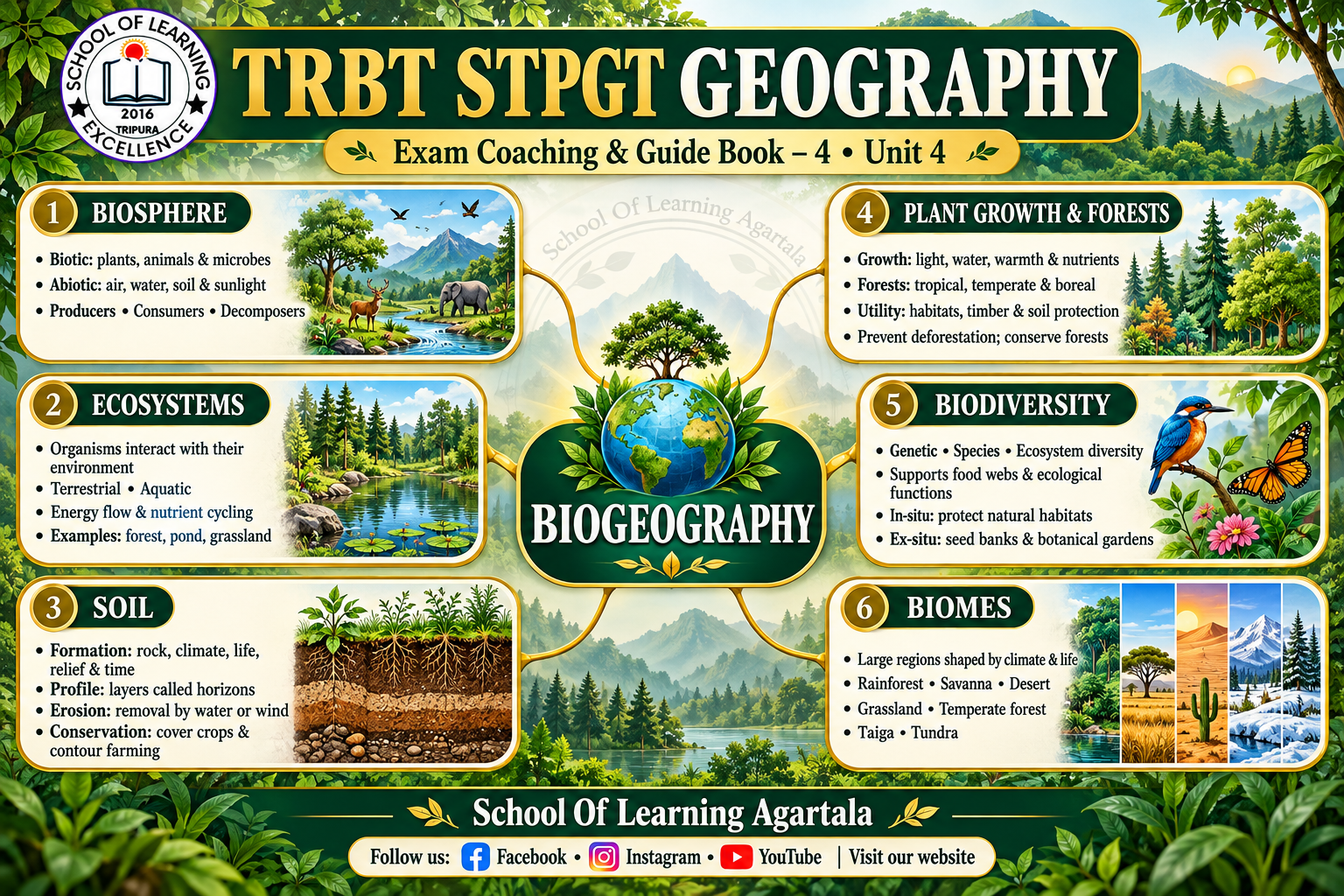 TRBT STPGT Biogeography Coaching in Tripura | SOL Agartala
TRBT STPGT Geography Biogeography: Coaching and Guide Book in Tripura
Why do different plants and animals occur in different regions? How does soil develop? Why are forests essential for ecological stability? Biogeography connects these questions by examining the distribution of living organisms and their relationship with the physical environment.
For students preparing for TRBT STPGT Geography in Tripura, Unit 4 covers the biosphere, ecosystems, soil formation, forests, biodiversity and biomes. These topics also help students understand the relationship between climate, landforms, vegetation and human activities.
School Of Learning Agartala’s Geography Guide Book 4: Biogeography provides a subject focus for studying this unit. Students seeking STPGT Geography coaching in Agartala can combine classroom learning with organised reading, visual revision and MCQ practice.
Components of the Biosphere
The biosphere includes the parts of Earth where life exists. It extends across portions of the atmosphere, hydrosphere and lithosphere, connecting living organisms with air, water and land.
Its components can be understood through two broad groups. Biotic components include plants, animals and microorganisms. Abiotic components include sunlight, temperature, water, air, soil and minerals.
Within ecological systems, producers, consumers and decomposers perform different functions. Green plants capture solar energy through photosynthesis. Consumers obtain energy by feeding on other organisms. Decomposers break down organic matter and help return nutrients to the environment.
A forest illustrates these connections: trees produce organic matter, animals depend on plants or other animals for food, and fungi and bacteria decompose fallen leaves. Soil, rainfall and temperature influence the entire system.
For TRBT STPGT Biogeography preparation, students should understand these relationships rather than study each component in isolation.
Ecosystem: Concept, Importance and Types
An ecosystem is a functional system in which organisms interact with one another and with their physical surroundings. Its size can range from a small pond to an extensive forest.
Ecosystems operate through energy flow and nutrient cycling. Energy enters most ecosystems through sunlight and passes through feeding relationships. Nutrients circulate between organisms and the physical environment.
Ecosystems can be classified into terrestrial and aquatic types. Forests, grasslands and deserts are terrestrial examples. Aquatic ecosystems include freshwater environments, such as ponds and rivers, and marine environments, such as seas and oceans. Agricultural fields are examples of ecosystems strongly managed by people.
Their importance includes providing habitats, supporting food production, regulating water movement, storing carbon and maintaining soil processes.
Students studying ecosystem notes for STPGT Geography should distinguish an ecosystem from a habitat. A habitat is the place where an organism lives; an ecosystem includes the interacting organisms and environmental processes.
Soil Formation, Soil Profile and Soil Conservation
Soil develops through the interaction of parent material, climate, organisms, relief and time. Weathering supplies mineral material, while plants and other organisms contribute organic matter and influence soil development.
Soil-forming processes include additions, losses, transformations and movement of materials within the soil. Humification produces humus from organic matter. Eluviation removes material from an upper horizon, while illuviation accumulates transported material in a lower horizon.
A soil profile is a vertical section showing soil horizons. Depending on the soil, these may include an organic surface layer, mineral topsoil, a leached horizon, subsoil and weathered parent material. Not every soil contains all horizons.
Soil erosion removes soil through agents such as running water and wind. Sheet erosion, rill erosion and gully erosion represent different forms of water erosion. Vegetation removal, unsuitable cultivation and exposed slopes can accelerate soil loss.
Conservation measures include:
- Contour cultivation and suitable terracing on slopes.
- Maintaining vegetation and protective ground cover.
- Mulching and cover crops.
- Shelterbelts in wind-affected areas.
- Controlled grazing and appropriate drainage.
For students in Tripura, considering how rainfall, slope and land use interact provides a useful way to apply soil-conservation concepts. The appropriate method depends on local conditions.
Factors of Plant Growth and World Distribution of Forests
Plant growth depends on sunlight, temperature, water, nutrients, soil aeration and other environmental conditions. The importance of each factor varies between species.
Climate strongly influences the broad distribution of forests. However, soil, relief, disturbance and human activity also shape vegetation patterns.
Tropical evergreen forests generally occur in warm regions with abundant moisture. Tropical deciduous forests occur where seasonal dryness encourages many trees to shed their leaves. Temperate deciduous forests develop in suitable middle-latitude environments, while boreal forests occupy extensive cold northern regions and are dominated largely by conifers.
Forests provide timber, fuel, fibres, food and other materials. They also support biodiversity, protect soil, influence water cycles and store carbon.
Students preparing world forest distribution notes should connect forest types with their climatic conditions and geographical occurrence. This makes vegetation patterns easier to understand and recall.
Deforestation and Forest Conservation
Deforestation involves the conversion of forest to another land use. It should be distinguished from forest degradation, in which a forest remains but loses ecological quality or productive capacity.
Agricultural expansion, infrastructure development, mining and other land-use pressures can cause forest loss. Its effects may include habitat fragmentation, increased soil erosion, altered water movement and the release of stored carbon.
Forest conservation includes protecting existing forests, restoring degraded areas, managing extraction and involving local communities. Afforestation and reforestation can contribute, but planting trees does not automatically recreate the biodiversity and ecological functions of a natural forest.
For Biogeography exam preparation in Tripura, students should connect forest conservation with livelihoods, soil protection and biodiversity rather than treat it only as tree planting.
Biodiversity: Concept and Importance
Biodiversity refers to the variety of life. It is commonly studied at three levels:
| Level | Meaning | Example |
|---|---|---|
| Genetic diversity | Variation within a species | Different varieties of rice |
| Species diversity | Variety of species in an area | Different trees, birds and insects in a forest |
| Ecosystem diversity | Variety of ecological systems | Forests, grasslands, rivers and wetlands |
Biodiversity supports food systems, pollination, nutrient cycling and many other ecological functions. It also provides cultural, scientific and economic benefits.
Major threats include habitat loss, overexploitation, pollution, invasive alien species and climate change.
In-situ conservation protects organisms in their natural environments. Ex-situ conservation protects biological material or organisms outside their natural habitats, as in seed banks and botanical gardens.
Students practising biodiversity MCQs for STPGT Geography should distinguish the three levels of diversity and the two conservation approaches clearly.
Concept and Classification of Biomes
A biome is a broad ecological region characterised by its climate and dominant vegetation, together with associated organisms. Biomes help explain large-scale patterns in the distribution of life.
Major terrestrial biomes include tropical rainforests, tropical seasonal forests and savannas, deserts, temperate grasslands, temperate forests, boreal forests and tundra. Classification systems differ in how they group and subdivide these regions.
| Biome | Broad characteristics |
|---|---|
| Tropical rainforest | Warm, moist conditions with dense vegetation |
| Savanna | Grassland with scattered trees and seasonal rainfall |
| Desert | Low moisture availability and drought-adapted organisms |
| Temperate grassland | Grass-dominated vegetation with seasonal temperature contrasts |
| Temperate deciduous forest | Seasonal leaf shedding and moderate climatic conditions |
| Boreal forest | Long, cold winters with extensive coniferous vegetation |
| Tundra | Short growing season and low-growing vegetation |
Aquatic environments are also classified into broad ecological categories, particularly freshwater and marine systems.
A useful distinction is that a biome is a broad regional category, while an ecosystem describes organisms interacting with their environment at a particular scale. Many individual ecosystems occur within a biome.
How to Prepare Biogeography for TRBT STPGT Geography
Begin with the connections between climate, soil, vegetation and organisms. Then study how human activities modify those relationships.
For effective revision, draw a soil profile, compare forest types and prepare a table of biome characteristics. Practise questions that distinguish weathering from soil formation, ecosystems from biomes, and conservation from restoration.
Use examples to reinforce definitions. A pond helps explain ecosystem interactions, rice varieties illustrate genetic diversity, and vegetation cover demonstrates how biological processes protect soil.
STPGT Geography Coaching in Tripura: School Of Learning Agartala
Students looking for TRBT STPGT Geography coaching in Tripura, Biogeography study materials or Geography Guide Book 4 can contact School Of Learning Agartala for course and publication details.
Offline and online learning options can support students preparing in Agartala and elsewhere in Tripura. Organised study of the biosphere, ecosystems, soils, forests, biodiversity and biomes builds a foundation for Unit 4.
Follow School Of Learning Agartala on Facebook, Instagram and YouTube. Visit our website for course information, study materials and academic updates.
Leave a Comments
Recent Post
-

-
 Tripura TET-II Exam 2026–27 18-10-2026
-
 Tripura TET-II Exam Science 2026–27 18-10-2026
-
-
Gallery
-
No image available.