 Online Store
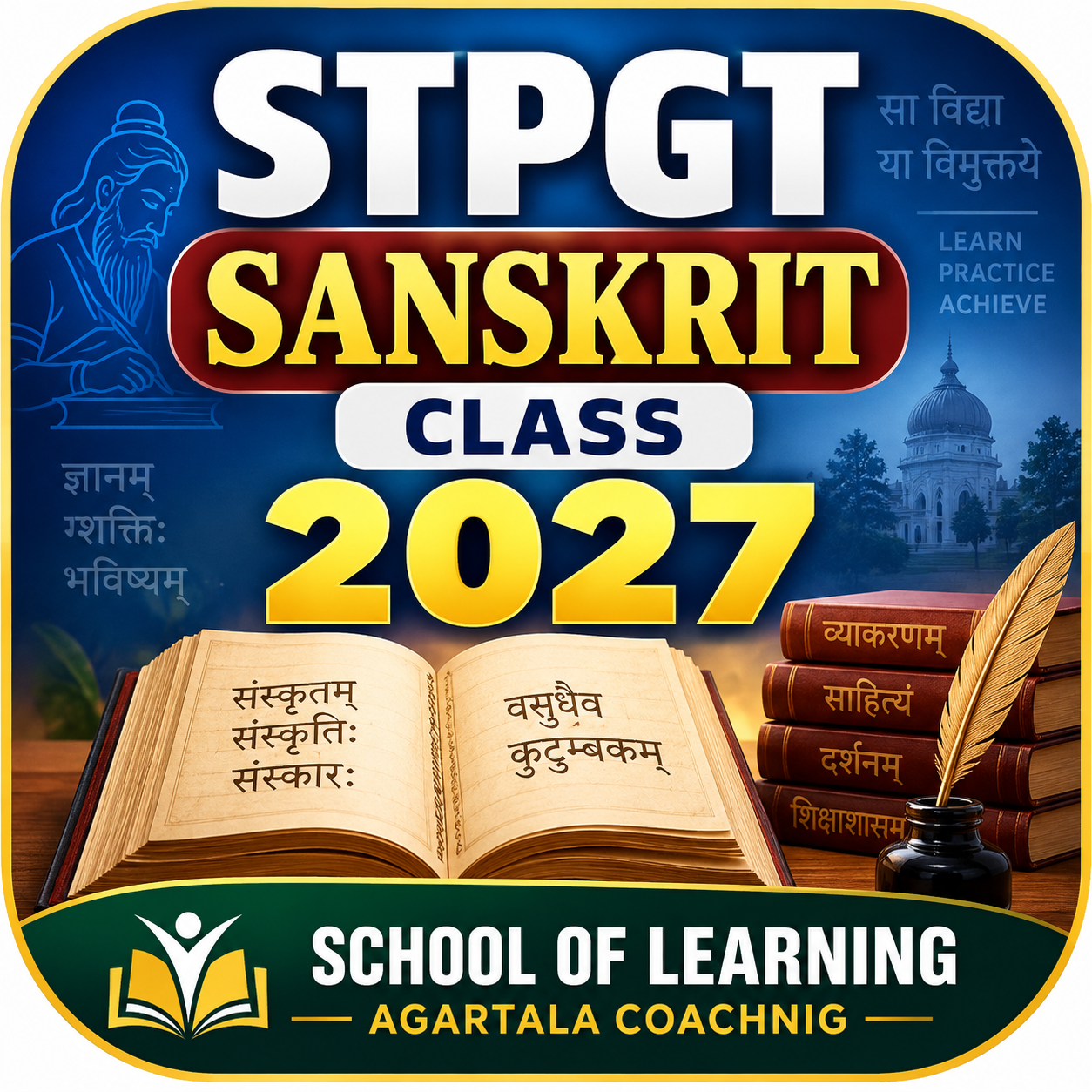
TRBT STPGT Sanskrit Coaching Agartala 2026–27
Candidates preparing for the TRBT Selection Test for Post Graduate Teacher (STPGT) – Sanskrit need a systematic approach that combines in-depth subject knowledge with objective examination practice. Sanskrit at the postgraduate level involves literature, grammar, linguistic concepts, important authors and texts, literary history and other syllabus-specific areas. Effective preparation therefore requires more than simply reading standard books.
School Of Learning Agartala (SOL) provides TRBT STPGT Sanskrit Coaching 2026–27 through a structured programme consisting of topic-wise classes, exam-oriented analysis, Previous Year Question (PYQ) solutions, regular practice tests, mock tests, lecture notes, study materials, revision and doubt-clearing sessions.
Both Offline and Online STPGT Sanskrit Classes are available, making the programme accessible to aspirants in Agartala as well as students from other parts of Tripura.
Latest STPGT Sanskrit Preparation 2026–27
Preparation for the upcoming STPGT Sanskrit examination should always be based on the latest applicable TRBT syllabus and examination requirements.
The course is organised to help students move progressively through the syllabus rather than studying unrelated chapters from different books. Each major unit is taught with an emphasis on conceptual understanding, important facts, authors and works, grammatical rules, terminology, frequently tested areas and MCQ-oriented preparation.
The overall preparation strategy follows:
Complete Syllabus → Topic-Wise Classes → Important Concepts → Focused Keywords → PYQ Analysis → MCQ Practice → Mock Tests → Revision
Topic-Wise STPGT Sanskrit Classes
One of the major features of the programme is topic-wise Sanskrit preparation.
Instead of merely completing chapters, each topic is analysed from the perspective of the competitive examination. Students are guided to understand the subject, identify important examination points and practise relevant objective questions.
For literature-oriented areas, the approach can follow:
Author → Period → Major Work → Literary Features → Important Characters/Concepts → Important Lines/Facts → PYQ → Expected MCQ
For grammar-oriented areas:
Rule → Definition → Classification → Example → Exception → Application → PYQ → MCQ Practice
This makes revision more organised and examination-focused.
Sanskrit Literature – Systematic Preparation
Sanskrit literature contains an extensive tradition of poetry, drama, prose and philosophical and religious writing. Students therefore need to organise their preparation carefully.
Important authors, works, literary characteristics, chronology and associated terminology are studied in a structured manner. Comparative preparation is especially useful because objective examinations can test candidates through author–work matching, chronological order, statements, terminology and textual identification.
Rather than memorising isolated facts, candidates should build connections among:
Author ↔ Work ↔ Period ↔ Genre ↔ Literary Features ↔ Important Facts
This method improves both recall and accuracy.
Sanskrit Grammar – Concept & Rule-Based Preparation
Grammar is another important component of Sanskrit preparation. Candidates need clarity regarding rules and their application rather than relying entirely on memorisation.
Classes therefore emphasise definitions, rules, classifications, examples, exceptions and question-solving methods wherever relevant to the official syllabus.
Regular practice is particularly important because similar grammatical constructions can create confusion in objective questions.
Exam-Oriented Analysis for STPGT Sanskrit
The programme places special emphasis on Exam-Oriented Analysis.
Postgraduate subject knowledge is broad, whereas a competitive examination requires candidates to identify exactly which concepts and facts can be converted into objective questions.
Students are therefore trained to analyse topics through:
Important Facts • Definitions • Authors & Works • Literary Terms • Grammar Rules • Chronology • Matching Questions • Statement-Based Questions • PYQs • Expected MCQs
The objective is to transform academic knowledge into selection-test preparation.
STPGT Sanskrit PYQ Analysis & Solutions
Previous Year Question analysis is an essential component of the preparation strategy.
Simply knowing the answer to a previous question provides limited benefit. Candidates should understand the concept behind the question and the reason the remaining alternatives are incorrect.
Our preferred PYQ method is:
PYQ → Correct Answer → Explanation → Related Rule/Concept → Why Other Options Are Wrong → Related Facts → Possible New Questions
This allows one previous question to become the basis for several related concepts and expected questions.
Regular Practice Tests
Continuous practice helps candidates determine whether they can actually recall concepts under examination conditions.
The programme therefore incorporates topic-wise MCQ practice, chapter-wise tests, unit-wise practice tests and revision tests.
Regular tests help candidates identify:
Strong Areas • Weak Areas • Conceptual Errors • Factual Errors • Confusing Topics • Time-Management Problems
The results can then be used to plan further revision.
STPGT Sanskrit Mock Tests
After sufficient syllabus coverage, candidates need exposure to examination-style tests.
Mock Tests are designed to improve speed, accuracy, question selection and examination temperament. Students can analyse incorrect responses after each test and revise the associated concepts.
Mock-test preparation is most effective when combined with:
Test → Error Analysis → Concept Revision → Re-Test
rather than simply attempting large numbers of questions.
Notes & Study Materials
A major challenge in postgraduate competitive examinations is managing the large quantity of available study material.
SOL's preparation programme therefore emphasises structured Sanskrit Notes & Study Materials designed to support both detailed study and quick revision.
Study resources can include:
Topic-Wise Theory • Important Definitions • Authors & Works • Focused Keywords • Grammar Rules • Important Facts • Tables • One-Liners • Topic-Wise MCQs • PYQ Solutions • Revision Notes • Practice Sets
These resources help students avoid depending entirely on scattered materials from multiple sources.
Dedicated Doubt-Clearing Sessions
Sanskrit grammar, literary terminology and text-related topics can generate conceptual doubts that should be resolved before revision begins.
The programme therefore includes Doubt-Clearing Sessions, where candidates can discuss difficult topics, grammatical rules, PYQs and confusing MCQ options with faculty.
Students can also use these sessions to strengthen weak areas identified through practice tests.
Experienced & Learner-Centric Faculty
Effective STPGT preparation requires faculty who can balance postgraduate subject depth with the requirements of an objective competitive examination.
The teaching approach at SOL is designed to be learner-centric and examination-oriented, with emphasis on clear explanation, regular interaction, practice and doubt resolution.
Students are encouraged to understand why an answer is correct, rather than simply memorising an answer key.
Offline STPGT Sanskrit Coaching in Agartala
Candidates who prefer face-to-face learning can join Offline STPGT Sanskrit Classes in Agartala.
Classroom coaching provides direct faculty interaction, a regular study schedule, immediate doubt clarification, peer discussion and continuous practice.
The SOL centre is located at Netaji Chowmuhani, Agartala.
Online STPGT Sanskrit Coaching in Tripura
Students who live outside Agartala can join the Online STPGT Sanskrit Classes.
Online learning allows candidates from different parts of Tripura to follow a structured preparation programme without travelling to Agartala for every class.
The online programme can integrate classes, notes, study materials, PYQ discussions, MCQ practice, tests, revision and doubt support, depending on the batch format.
? STPGT Sanskrit Successful Achievers – 2025
The success of previous students is an important source of motivation for new aspirants.
Our Successful STPGT Sanskrit Students – 2025
PROUD ACHIEVERS – STPGT SANSKRIT 2025
Successful Students of School Of Learning Agartala
Your Success • Our Motivation
Best STPGT Sanskrit Coaching in Tripura
Candidates searching online commonly use phrases such as “Best STPGT Sanskrit Coaching in Tripura,” “Best Sanskrit Coaching in Agartala,” and “Best STPGT Coaching Institute in Tripura.”
These are useful SEO target keywords. In promotional copy, it is stronger to support the positioning with concrete programme features rather than make an unsupported absolute ranking claim.
SOL can position itself as a leading choice for TRBT STPGT Sanskrit Coaching in Tripura, based on its combination of:
Topic-Wise Classes • Exam-Oriented Analysis • PYQ Solutions • Regular Practice Tests • Mock Tests • Notes & Study Materials • Doubt-Clearing Sessions • Experienced Faculty • Offline + Online Classes • Successful Students
Why Choose School Of Learning for STPGT Sanskrit?
Students preparing for TRBT STPGT Sanskrit 2026–27 receive a preparation structure centred on complete syllabus coverage, conceptual learning, examination-oriented analysis, PYQ discussion, MCQ practice, regular testing, mock examinations, systematic revision and individual doubt support.
The availability of both Offline Classes in Agartala and Online Classes also makes the programme suitable for candidates across Tripura.
Admission Open – TRBT STPGT Sanskrit 2026–27
Start your preparation with a clear selection-oriented strategy:
Learn → Understand → Analyse → Practise → Test → Revise → Succeed
School Of Learning Agartala
? Netaji Chowmuhani, Agartala, Tripura
? Call / WhatsApp: 7005828529
WE ENHANCE YOUR TALENT
Our Syllabus

WE ENHANCE YOUR TALENT
Recommended Courses