 Online Store
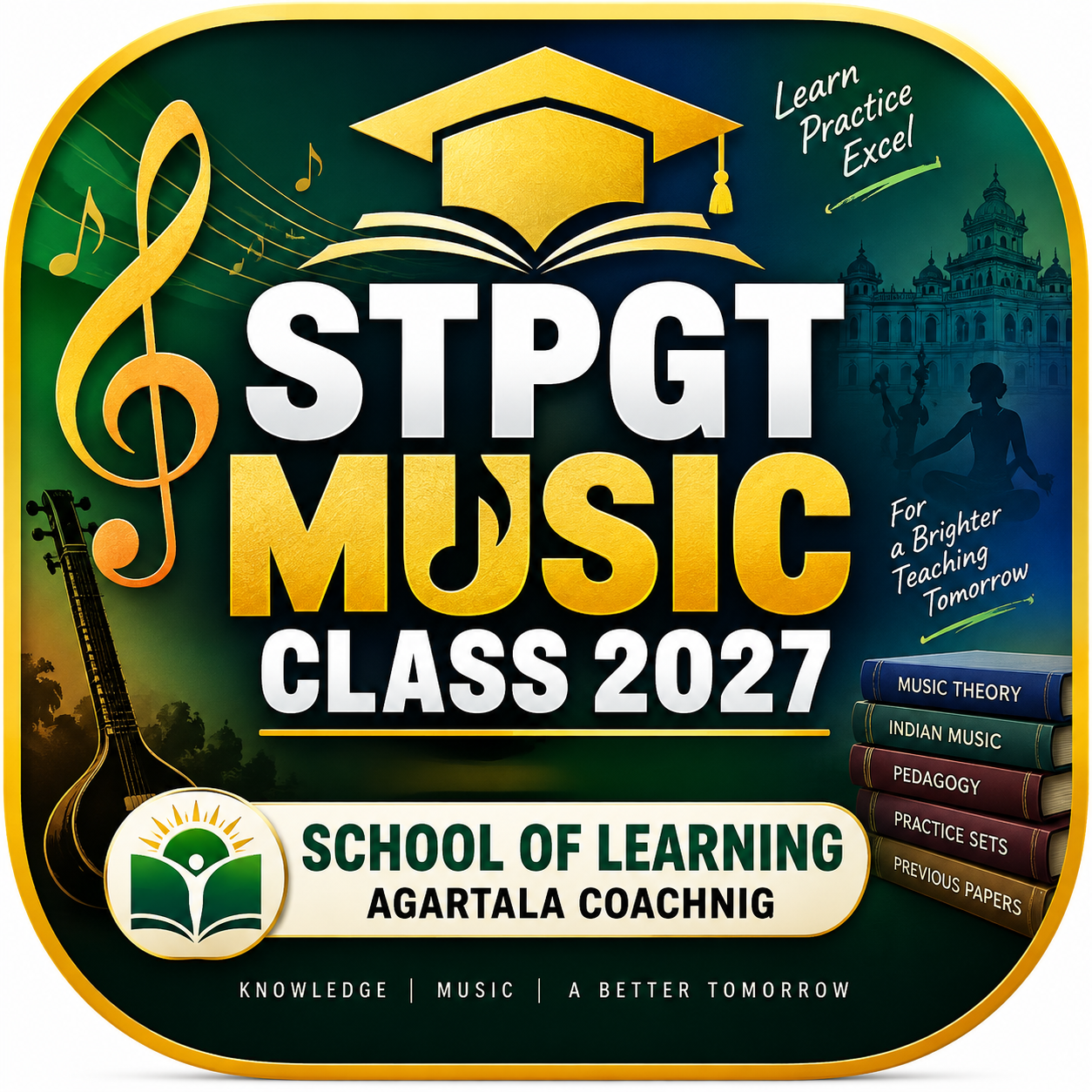
The reported 125 vacancies for Tripura STPGT Music Teachers 2026 may create an important career opportunity for qualified Music candidates in Tripura. Aspirants who want to become postgraduate teachers should begin their subject preparation early rather than waiting until the examination date is announced.
School of Learning Agartala offers specialised guidance through its Tripura STPGT Music Class 2026-27, helping candidates prepare with syllabus-based lessons, theoretical explanations, practical guidance, study materials and regular assessments.
Important notice: Candidates must confirm the final number of vacancies, eligibility requirements, category-wise distribution, application dates and selection rules from the official TRBT recruitment notification. The Teachers’ Recruitment Board, Tripura, currently provides an official STPGT Music syllabus and an STPGT Music previous-year question paper.
Tripura STPGT Music Teacher Recruitment 2026-27: Overview
The expected recruitment has generated considerable interest among postgraduate Music candidates. However, securing a teaching position requires more than general knowledge of music.
Candidates need:
- Strong understanding of Indian classical music
- Knowledge of important musical terms and theories
- Familiarity with ragas, talas and compositions
- Understanding of the history and development of Indian music
- Knowledge of renowned musicians and musicologists
- Awareness of musical instruments and performance traditions
- Regular practice with syllabus-based questions
- Effective revision and examination strategy
The Tripura STPGT Music Class 2026 at SOL Agartala is designed to organise these areas into a focused preparation programme.
Why Should Candidates Start Preparing Early?
Music is a specialised subject containing theoretical, historical and practical elements. The syllabus cannot be completed effectively through last-minute preparation.
Beginning early gives candidates sufficient time to:
- Understand every unit of the syllabus
- Strengthen fundamental musical concepts
- Revise ragas and talas repeatedly
- Study the historical development of music
- Prepare concise notes for important topics
- Practise previous-year and model questions
- Identify and improve weak areas
- Attempt regular tests before the examination
A systematic preparation plan can help candidates approach the examination with greater accuracy and confidence.
Major Areas of STPGT Music Preparation
Candidates should follow the latest official syllabus while preparing. Important areas may include the following:
Fundamentals of Indian Music
The programme helps students revise important concepts such as:
- Shruti and swara
- Saptak
- Varna
- Alankar
- Aroha and avaroha
- Vadi, samvadi, anuvadi and vivadi
- Pakad and chalan
- Laya and tala
- Raga and rasa
- Forms of Indian music
Clear understanding of musical terminology is essential for answering conceptual and objective questions.
Raga Studies
Candidates receive systematic guidance on:
- Characteristics of important ragas
- Thaat and raga classification
- Jati of ragas
- Vadi and samvadi swaras
- Time theory of ragas
- Aroha, avaroha and pakad
- Similarities and differences between ragas
- Important compositions
Comparison-based study can help students distinguish between closely related ragas.
Tala and Laya
Important areas may include:
- Meaning and structure of tala
- Matra, vibhag, sam, tali and khali
- Different layas
- Theka and bol
- Common Hindustani talas
- Tala notation
- Layakari
- Relationship between rhythm and composition
Regular written and oral practice helps candidates retain rhythmic structures more effectively.
History of Indian Music
The historical section may cover:
- Music in ancient India
- Music during the medieval period
- Development of modern Indian music
- Hindustani and Carnatic traditions
- Gharanas and musical styles
- Contribution of saints and scholars
- Development of music education
- Important texts on Indian music
A chronological study method can make historical facts easier to remember.
Musical Forms and Compositions
Candidates may study:
- Dhrupad
- Dhamar
- Khayal
- Thumri
- Tappa
- Tarana
- Bhajan
- Ghazal
- Folk music
- Rabindra Sangeet and other relevant traditions
The origin, structure and distinctive features of each musical form should be studied carefully.
Musical Instruments
This area may include:
- Classification of Indian musical instruments
- String instruments
- Wind instruments
- Percussion instruments
- Construction and playing techniques
- Role of instruments in Indian classical music
- Contributions of renowned instrumentalists
Visual identification and comparison can improve retention.
Musicians and Musicologists
Candidates should prepare concise notes on:
- Important classical vocalists
- Instrumentalists
- Composers
- Musicologists
- Their gharanas, styles and contributions
- Major musical works and achievements
Music Education and Pedagogy
As the examination relates to teaching, candidates may also benefit from understanding:
- Objectives of music education
- Methods of teaching music
- Lesson planning
- Classroom demonstration
- Assessment of musical learning
- Role of technology in music education
- Development of creativity and performance skills
Features of Tripura STPGT Music Class 2026 at SOL Agartala
Syllabus-Based Teaching
Classes are organised according to the relevant subject areas, helping students prepare systematically.
Theory and Practical Guidance
The programme supports both theoretical understanding and the practical interpretation of musical concepts.
Topic-Wise Study Materials
Organised notes help candidates revise important terms, ragas, talas, musicians, instruments and historical developments.
Previous-Year Question Practice
Candidates practise earlier questions to understand common patterns and important areas of preparation.
Regular Tests and Mock Examinations
Tests help students assess their progress, improve time management and identify weak areas.
Doubt-Clearing Support
Candidates can seek clarification on theoretical concepts, notation, ragas, talas and historical topics.
Revision Guidance
Planned revision helps candidates retain detailed musical information and prepare confidently for the examination.
How to Prepare for Tripura STPGT Music 2026
Candidates can follow this preparation strategy:
- Download and study the latest official syllabus.
- Divide the syllabus into theory, history, raga, tala and pedagogy.
- Prepare a realistic weekly timetable.
- Create short notes for definitions and musical terminology.
- Maintain separate charts for ragas and talas.
- Study the contributions of important musicians and musicologists.
- Practise musical notation regularly.
- Solve previous-year and topic-wise questions.
- Attempt tests within a fixed time.
- Revise weak topics repeatedly.
Who Can Join the STPGT Music Classes?
The programme is suitable for:
- Aspirants preparing for Tripura STPGT Music recruitment
- Postgraduate students of Music
- Trained vocal and instrumental music candidates
- Candidates aspiring to become postgraduate Music teachers
- Students seeking structured syllabus guidance
- Aspirants looking for study materials, tests and revision support
Final eligibility must be checked from the official recruitment notification.
Begin Your STPGT Music Preparation Today
The reported 125 Tripura STPGT Music Teacher vacancies in 2026 could offer a valuable opportunity for eligible candidates. Early and disciplined preparation can provide enough time to complete the syllabus, strengthen difficult topics and practise examination-oriented questions.
Join the Tripura STPGT Music Class 2026 at School of Learning Agartala and prepare through systematic academic guidance.
Admission and Contact Details
School of Learning Agartala
Address: Netaji Chowmuhani, Agartala, Tripura
Phone: 7005828529
Contact the institute for information about admission, class schedules, study materials and available learning modes.
Learn with discipline. Practise with dedication. Prepare confidently for Tripura STPGT Music 2026.
WE ENHANCE YOUR TALENT
Our Syllabus

WE ENHANCE YOUR TALENT
Recommended Courses