 Online Store
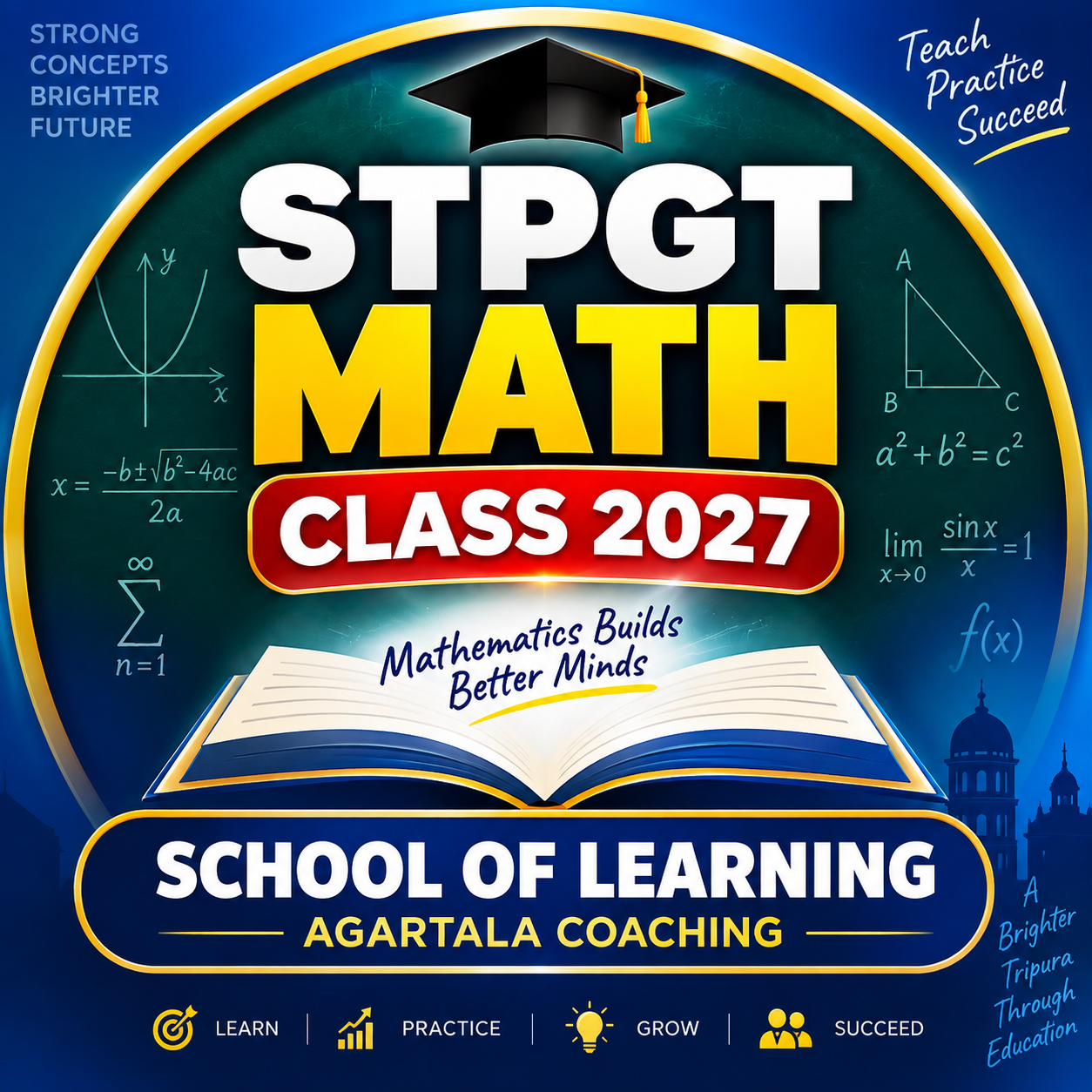
Preparing for the Tripura STPGT Mathematics Exam 2026 requires conceptual clarity, strong problem-solving skills and consistent practice. To support aspiring postgraduate teachers, School of Learning Agartala offers specialised academic guidance through its Tripura STPGT Mathematics Class 2026.
The programme is designed to help candidates strengthen their mathematical foundations, complete the syllabus systematically and practise examination-oriented questions with confidence.
Why Is Proper Guidance Important for STPGT Mathematics?
Mathematics is a logical and application-based subject. Candidates must understand mathematical principles, formulas, proofs and problem-solving techniques instead of relying only on memorisation.
Effective preparation requires:
- Clear understanding of fundamental concepts
- Systematic coverage of the prescribed syllabus
- Regular practice of mathematical problems
- Knowledge of important formulas and theorems
- Ability to select the correct problem-solving method
- Improvement in calculation speed and accuracy
- Regular revision of difficult topics
- Practice through tests and mock examinations
The Tripura STPGT Mathematics Class 2026 provides a structured combination of concept learning, question practice, revision and assessment.
Major Areas Covered in STPGT Mathematics Classes
The programme focuses on the principal areas generally required for postgraduate-level Mathematics preparation.
Algebra
Important areas include:
- Groups and subgroups
- Cyclic groups
- Permutation groups
- Normal subgroups and quotient groups
- Homomorphism and isomorphism
- Rings, ideals and fields
- Vector spaces
- Linear transformations
- Matrices and determinants
- Eigenvalues and eigenvectors
Students receive step-by-step guidance in definitions, theorems, proofs and problem-solving applications.
Real Analysis
The Real Analysis section covers:
- Sets and functions
- Sequences and series
- Limits and continuity
- Differentiability
- Riemann integration
- Uniform convergence
- Metric spaces
- Compactness and connectedness
- Functions of several variables
Emphasis is placed on conceptual understanding, mathematical reasoning and theorem-based questions.
Complex Analysis
Candidates are guided through topics such as:
- Complex numbers
- Analytic functions
- Cauchy–Riemann equations
- Complex integration
- Cauchy’s theorem
- Taylor and Laurent series
- Singularities
- Residue theorem
- Conformal mapping
The classes combine theoretical explanations with problem-solving practice.
Differential Equations
Important areas include:
- First-order differential equations
- Higher-order differential equations
- Linear differential equations
- Series solutions
- Partial differential equations
- Laplace transforms
- Boundary-value problems
- Applications of differential equations
Students learn how to identify the correct method and solve equations systematically.
Calculus
The Calculus section includes:
- Limits and continuity
- Differentiation
- Successive differentiation
- Maxima and minima
- Indefinite and definite integration
- Multiple integrals
- Vector calculus
- Applications of derivatives and integrals
Regular practice helps candidates improve accuracy and speed in calculation-based questions.
Coordinate Geometry and Vector Analysis
Students receive guidance on:
- Straight lines and circles
- Conic sections
- Three-dimensional geometry
- Planes and spheres
- Scalar and vector products
- Gradient, divergence and curl
- Line and surface integrals
- Green’s, Gauss’s and Stokes’ theorems
Diagrams and step-by-step solutions are used to simplify complex geometrical ideas.
Numerical Analysis
This section covers:
- Errors and approximations
- Solutions of algebraic equations
- Interpolation
- Numerical differentiation
- Numerical integration
- Numerical solutions of differential equations
- Iterative methods
- Finite-difference methods
Special attention is given to formulas, algorithms and numerical accuracy.
Probability and Statistics
Important topics include:
- Basic probability
- Conditional probability
- Bayes’ theorem
- Random variables
- Probability distributions
- Mathematical expectation
- Correlation and regression
- Sampling theory
- Estimation and hypothesis testing
Students practise both conceptual and calculation-based questions.
Mechanics and Mathematical Modelling
Candidates are guided through areas such as:
- Statics and dynamics
- Motion of particles
- Work, energy and momentum
- Simple harmonic motion
- Central forces
- Rigid-body motion
- Mathematical formulation of physical problems
Features of the Tripura STPGT Mathematics Class 2026
Concept-Based Teaching
Every chapter begins with the fundamental concepts before progressing to advanced theories, proofs and examination-level problems.
Structured Syllabus Coverage
The syllabus is divided into manageable units so that candidates can prepare systematically and track their progress.
Step-by-Step Problem-Solving
Questions are explained through logical and organised steps, helping students understand both the method and the final answer.
Topic-Wise Practice
Regular practice sets help candidates identify weak areas and improve their command of important topics.
Tests and Mock Examinations
Chapter tests, revision tests and full-length mock examinations help students improve speed, accuracy and time management.
Doubt-Clearing Support
Candidates can clarify difficult concepts, proofs and mathematical problems during doubt-clearing sessions.
Study Materials and Revision Guidance
Organised notes and practice materials support the revision of formulas, theorems, definitions and problem-solving methods.
How to Prepare for Tripura STPGT Mathematics 2026
Candidates can follow these steps for effective preparation:
- Read the official syllabus carefully.
- Divide the syllabus into major mathematical branches.
- Create a realistic weekly study timetable.
- Understand concepts before memorising formulas.
- Maintain separate notes for formulas and theorems.
- Solve mathematical problems every day.
- Revise important proofs and definitions regularly.
- Practise questions of different difficulty levels.
- Attempt topic-wise and full-length mock tests.
- Analyse mistakes and revise weak chapters.
Mathematics cannot be mastered through passive reading. Regular written practice is essential for developing accuracy, speed and confidence.
Who Can Join the STPGT Mathematics Classes?
The programme is suitable for:
- Candidates preparing for the Tripura STPGT Mathematics examination
- Postgraduate students of Mathematics
- Aspiring postgraduate teachers
- Candidates seeking structured syllabus guidance
- Students who need support with advanced mathematical problems
- Aspirants looking for regular tests and revision guidance
Start Your STPGT Mathematics Preparation Today
Success in a competitive teaching examination depends on subject knowledge, consistent practice and proper time management. Starting early provides enough time to complete the syllabus, strengthen difficult topics and attempt mock examinations.
Join the Tripura STPGT Mathematics Class 2026 at School of Learning Agartala and prepare through systematic academic guidance.
Admission and Contact Details
School of Learning Agartala
Address: Netaji Chowmuhani, Agartala, Tripura
Phone: 7005828529
Contact the institute for information about admission, class schedules, study materials and available learning modes.
Build strong concepts. Practise consistently. Prepare confidently for Tripura STPGT Mathematics 2026.
WE ENHANCE YOUR TALENT
Our Syllabus

WE ENHANCE YOUR TALENT
Recommended Courses