 Online Store
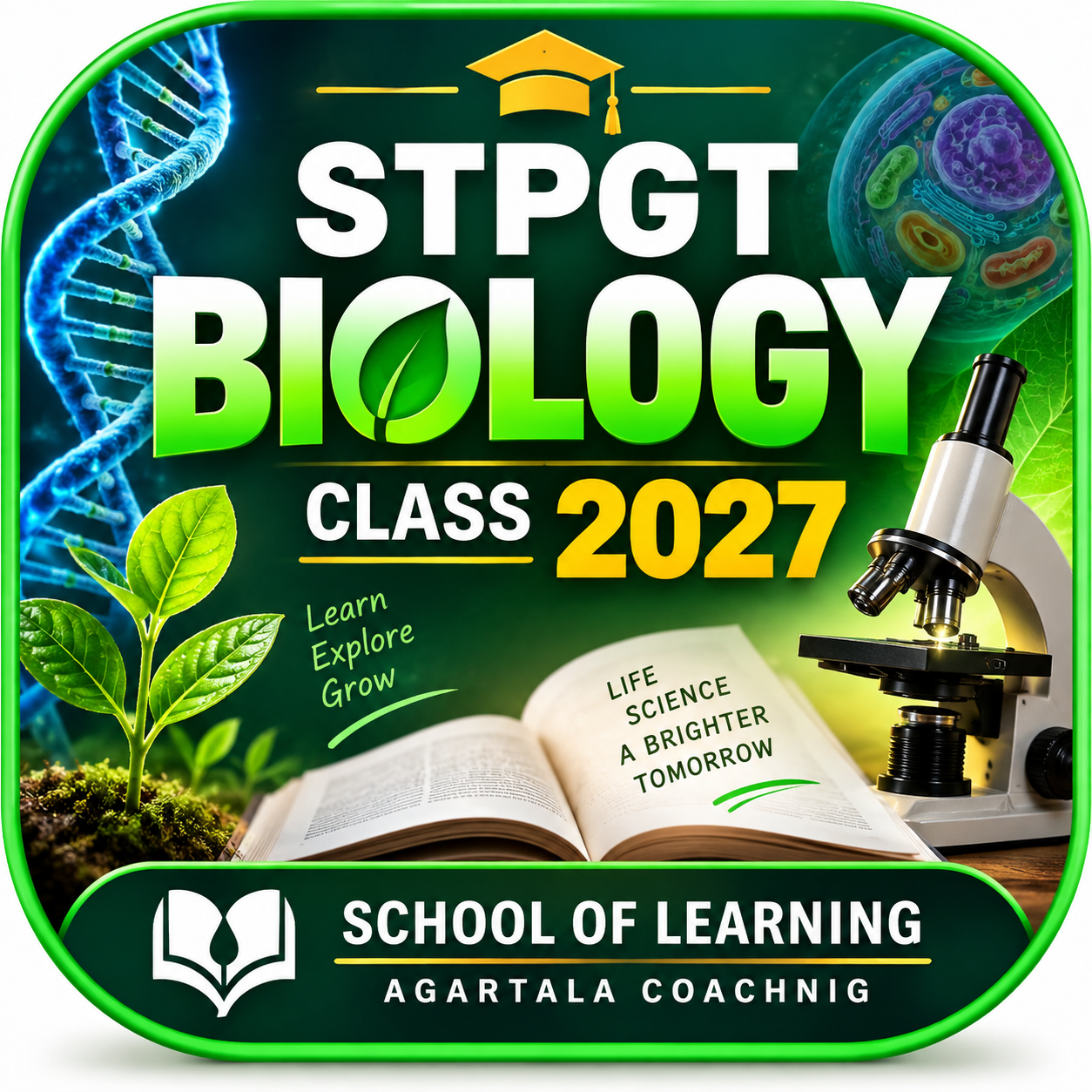
Preparing for the Tripura STPGT Biology Exam 2026 requires comprehensive knowledge of Botany, Zoology and related life-science concepts. Candidates must understand biological processes, scientific terminology, diagrams, classifications and practical applications.
To support aspiring postgraduate teachers, School of Learning Agartala offers specialised academic guidance through its Tripura STPGT Biology Class 2026.
The programme is designed to help candidates strengthen their subject knowledge, complete the syllabus systematically and practise examination-oriented questions with confidence.
Why Is Proper Guidance Important for STPGT Biology?
Biology is a broad subject consisting of interconnected concepts. Candidates need to understand how biological structures, functions and processes relate to one another instead of depending entirely on memorisation.
Effective preparation requires:
- Clear understanding of Botany and Zoology
- Systematic coverage of the prescribed syllabus
- Accurate use of scientific terminology
- Regular revision of classifications and examples
- Practice with diagrams and biological processes
- Understanding of experiments and applications
- Topic-wise question practice
- Regular tests and mock examinations
The Tripura STPGT Biology Class 2026 provides a structured combination of concept learning, revision, question practice and assessment.
Major Areas Covered in STPGT Biology Classes
The programme focuses on the major areas generally required for postgraduate-level Biology preparation. Candidates should always match their preparation with the latest official syllabus.
Cell Biology
Important topics include:
- Cell structure and organisation
- Prokaryotic and eukaryotic cells
- Cell membrane and transport
- Cell organelles
- Cell cycle
- Mitosis and meiosis
- Cell signalling
- Cellular communication
- Apoptosis
Diagrams and concept-based explanations help students understand cellular structures and functions.
Genetics and Molecular Biology
Students receive guidance on:
- Mendelian genetics
- Linkage and crossing over
- Chromosomal variations
- Mutation
- DNA structure and replication
- RNA and transcription
- Genetic code and translation
- Gene regulation
- Recombinant DNA technology
- Genomics and biotechnology
Special attention is given to genetic crosses, molecular mechanisms and problem-based questions.
Plant Diversity and Taxonomy
This section may include:
- Algae
- Fungi
- Bryophytes
- Pteridophytes
- Gymnosperms
- Angiosperms
- Principles of taxonomy
- Botanical nomenclature
- Plant classification
- Economic importance of plants
Students learn important characteristics, life cycles, examples and evolutionary relationships.
Plant Anatomy and Physiology
Important areas include:
- Plant tissues
- Internal structure of roots, stems and leaves
- Water absorption and transport
- Mineral nutrition
- Photosynthesis
- Respiration
- Plant growth and development
- Plant hormones
- Photoperiodism and vernalisation
- Stress physiology
The classes focus on processes, experiments, diagrams and scientific explanations.
Animal Diversity
Candidates study the classification and characteristics of:
- Protozoans
- Porifera
- Cnidaria
- Platyhelminthes
- Nematoda
- Annelida
- Arthropoda
- Mollusca
- Echinodermata
- Chordata
Comparative features, examples, adaptations and evolutionary relationships are explained systematically.
Animal Physiology
This section covers:
- Digestion and nutrition
- Respiration
- Circulation
- Excretion
- Nervous coordination
- Muscle physiology
- Endocrine system
- Reproductive physiology
- Homeostasis
- Sensory mechanisms
Students receive concept-based guidance supported by diagrams and comparative explanations.
Ecology and Environmental Biology
Important topics include:
- Ecosystem structure and function
- Energy flow
- Food chains and food webs
- Population ecology
- Community ecology
- Ecological succession
- Biogeochemical cycles
- Biodiversity
- Environmental pollution
- Wildlife conservation
Examples from natural ecosystems help students connect ecological theories with practical situations.
Evolution and Behaviour
The programme may cover:
- Origin of life
- Evidences of evolution
- Lamarckism and Darwinism
- Natural selection
- Modern synthetic theory
- Speciation
- Human evolution
- Animal behaviour
- Social behaviour
- Biological rhythms
Students are guided to understand the evidence, mechanisms and significance of evolutionary processes.
Microbiology and Immunology
Important areas include:
- Bacteria and viruses
- Microbial growth
- Microbial genetics
- Applied microbiology
- Innate and adaptive immunity
- Antigens and antibodies
- Immune responses
- Vaccines
- Hypersensitivity
- Autoimmunity
Biotechnology and Applied Biology
Students receive guidance on:
- Genetic engineering
- Cloning vectors
- Polymerase chain reaction
- DNA sequencing
- Tissue culture
- Bioinformatics
- Agricultural biotechnology
- Medical biotechnology
- Environmental biotechnology
- Ethical concerns in biotechnology
Features of the Tripura STPGT Biology Class 2026
Concept-Based Teaching
Each chapter begins with fundamental concepts before moving to advanced biological processes and examination-level questions.
Botany and Zoology Coverage
The programme provides balanced guidance across the major areas of plant science, animal science and molecular biology.
Diagram-Based Explanation
Biological structures, pathways and life cycles are explained with clear diagrams wherever required.
Topic-Wise Practice
Practice questions after important chapters help candidates evaluate their understanding and identify weak areas.
Regular Tests and Mock Examinations
Chapter tests, revision tests and mock examinations help students improve accuracy, confidence and time management.
Doubt-Clearing Support
Candidates can clarify difficult concepts, classifications, diagrams and biological mechanisms during doubt-clearing sessions.
Study Materials and Revision Guidance
Organised notes and practice materials support the revision of terminology, scientific processes, classifications and important examples.
How to Prepare for Tripura STPGT Biology 2026
Candidates can follow these steps for effective preparation:
- Read the latest official syllabus carefully.
- Divide the syllabus into Botany, Zoology and common life-science units.
- Prepare a realistic weekly study schedule.
- Understand biological processes instead of memorising isolated facts.
- Create short notes for terminology, classifications and examples.
- Practise labelled diagrams regularly.
- Prepare comparison tables for related biological groups.
- Revise genetics and molecular pathways repeatedly.
- Attempt topic-wise and full-length mock tests.
- Analyse incorrect answers and revise weak chapters.
Biology requires both conceptual understanding and factual recall. Regular revision is therefore essential for retaining scientific terms, examples, processes and classifications.
Who Can Join the STPGT Biology Classes?
The programme is suitable for:
- Candidates preparing for the Tripura STPGT Biology examination
- Postgraduate students of Botany, Zoology or related life-science subjects
- B.Ed Degree Required
- Candidates seeking structured syllabus guidance
- Students who need assistance with diagrams and complex biological processes
- Aspirants looking for tests, practice questions and revision support
Start Your STPGT Biology Preparation Today
Success in a competitive teaching examination depends on subject knowledge, consistent revision and regular question practice. Starting early provides enough time to complete the syllabus, strengthen difficult concepts and attempt mock examinations.
Join the Tripura STPGT Biology Class 2026 at School of Learning Agartala and prepare through systematic academic guidance.
Admission and Contact Details
School of Learning Agartala
Address: Netaji Chowmuhani, Agartala, Tripura
Phone: 7005828529
Contact the institute for information about admission, class schedules, study materials and available learning modes.
Understand life scientifically. Revise systematically. Prepare confidently for Tripura STPGT Biology 2026.
WE ENHANCE YOUR TALENT
Our Syllabus

WE ENHANCE YOUR TALENT
Recommended Courses